

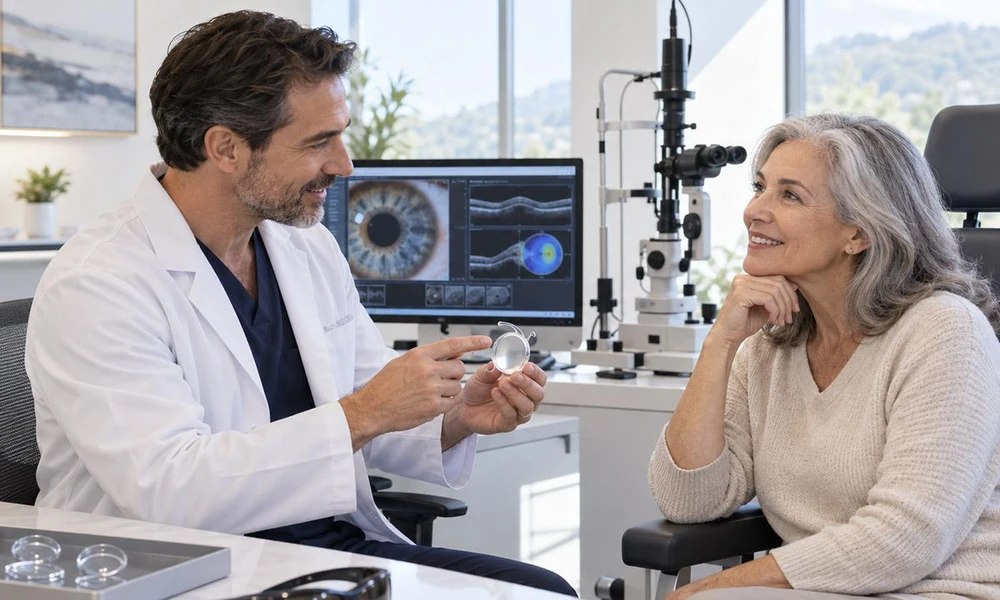
The Light Adjustable Lens (LAL) from RxSight is an FDA-approved cataract lens implant that can be adjusted after surgery. Once the eye heals, a few short in-office UV light treatments reshape the lens to fine-tune your prescription, and lock-in sessions make it permanent. Patients wear UV-protective glasses until 24 hours after the final lock-in. It may help eyes with astigmatism or prior LASIK, but it isn’t right for everyone.
In the clinical trial that led to FDA approval, about 70% of eyes that received the light-adjustable lens saw 20/20 or better at distance without glasses six months later. Among eyes with a standard lens, the figure was about 36%. Averages aren’t guarantees, but that gap reflects one unusual feature: the light adjustable lens is the only type of lens implant that can be customized after it’s already inside the eye.
Cataract surgery replaces the eye’s cloudy natural lens with a clear artificial one. For decades, the power of that implant had to be chosen before surgery and stayed fixed once it was placed. Any small leftover prescription was usually handled with glasses.
Anaheim Eye Institute has cared for Orange County patients since 1958. This article explains why lens calculations sometimes miss, how the adjustable light lens works, what the adjustment weeks involve, what the research shows, and whether it may fit your eyes and your schedule.
Why Cataract Surgery Doesn’t Always Deliver Glasses-Free Vision
Cataract surgery replaces the cloudy natural lens with a clear implant whose power is chosen beforehand, based on measurements of your eye. That calculation is a highly refined estimate, but healing and anatomy can leave a small leftover prescription, especially in eyes with astigmatism or previous LASIK, PRK, or radial keratotomy.
During cataract surgery, many patients receive a monofocal lens, which is set to focus at one distance. The American Academy of Ophthalmology (AAO) guide to choosing a lens implant notes that Medicare and most insurance plans cover this standard lens. Premium lenses aim to reduce reliance on glasses and usually cost more.
With a traditional implant, the power is permanent. If the eye heals slightly differently than predicted, or if astigmatism (an uneven curve of the cornea that blurs vision) isn’t fully corrected, a mild residual prescription may remain.
Previous laser vision correction adds another layer. LASIK, PRK, and radial keratotomy change the shape of the cornea, which makes the formulas used to choose lens power less predictable. As those patients reach cataract age, this question comes up often.
What the Light Adjustable Lens Is and How Light Changes It
The Light Adjustable Lens is a silicone lens implant made by RxSight that contains light-sensitive molecules. After the eye heals, a special device shines a precise pattern of ultraviolet (UV) light onto the lens. Over the following hours, the lens changes shape to correct leftover nearsightedness, farsightedness, or astigmatism.
The FDA approved the lens on November 22, 2017, describing it in its approval announcement as the first implanted lens that can be adjusted after cataract surgery. According to EyeWiki, the AAO’s clinical encyclopedia, the lens material contains light-reactive building blocks called macromers. When targeted UV light reaches the lens, molecules in that area link together and the rest gradually shift over about 12 hours, changing the lens’s curvature and power.
Each session is quick. The AAO explains that treatments take about one to two minutes, and vision typically improves by the next morning.
A newer version, LAL+, launched in the United States in April 2024, according to industry coverage of the launch. Its modified front surface is designed to extend depth of focus modestly. You can read more about the Light Adjustable Lens at Anaheim Eye Institute.
The Light Adjustable Lens Adjustment Period: Light Treatments, UV Glasses, and Lock-In
About two to three weeks after surgery, patients begin a series of short in-office light treatments, usually a few days apart. Most people have a few treatments, often three or four in total, including lock-in, which makes the prescription permanent. UV-protective glasses are worn during waking hours until 24 hours after the final lock-in.
Timing and Number of Treatments
The FDA’s 2017 announcement described three or four light treatments over one to two weeks, each lasting roughly 40 to 150 seconds. Current labeling allows for fewer, and your surgeon decides how many you need based on your results.
Anaheim Eye’s LAL page notes that the adjustment period typically lasts 4 to 6 weeks after surgery. It includes multiple follow-up visits where your eyes are dilated, so ask the office whether you should arrange a ride.
Test-Driving Your Vision
Between treatments, you live with your adjusted vision in everyday settings. You can notice how reading, driving, and screens feel, then share your priorities with your surgeon before the next adjustment, though no specific outcome can be promised.
Why the UV Glasses Matter
Because the lens responds to UV light, sunlight can change it too. RxSight’s information for eye care professionals explains that unprotected UV exposure can cause unpredictable changes, which could potentially require removing the lens. That’s why patients wear RxSight-specified UV-protective glasses during all waking hours, indoors and outdoors, from surgery until 24 hours after the final lock-in.
In Southern California, where bright sun is part of most days, that routine takes planning. It doesn’t mean staying indoors, but it does mean keeping the glasses on consistently.
Locking In the Result
Once you and your surgeon are satisfied with your vision, a lock-in treatment fixes the final prescription in place. Twenty-four hours after the final lock-in, the UV glasses requirement ends, and your usual sunglasses routine can resume.
What the Clinical Research Shows
The FDA’s Summary of Safety and Effectiveness Data describes the pivotal trial behind the approval. It included 600 eyes at 17 U.S. sites, with 403 receiving the light adjustable lens and 197 receiving a standard monofocal lens.
At six months, 70.1% of LAL eyes saw 20/20 or better at distance without glasses, compared with 36.3% of standard lens eyes. In eyes with meaningful astigmatism before surgery, the LAL group averaged a 74.6% reduction in astigmatism, versus 19.9% in the standard group. These are group results, and individual outcomes vary.
Safety for best-corrected vision was strong, with every participant in both groups reaching 20/40 or better with glasses at six months. The most common side effect was a temporary pink tint to vision after treatments (called erythropsia), reported in 58.3% of LAL eyes and resolved by six months in 99.5% of them.
Secondary surgical procedures were more common with the LAL (1.7% versus 0.5%). One eye (0.2%) had retinal light damage linked to a faulty UV filter, and that patient’s vision recovered.
Eyes with previous corneal surgery, including LASIK and PRK, were excluded from that trial, but smaller studies have since looked at this group. A 2023 study in Clinical Ophthalmology followed 34 eyes with prior LASIK or PRK that received a second-generation LAL. It found that 82.4% reached 20/20 or better and 97.1% landed within 0.50 diopters of their target, encouraging results from a small study.
“With a light adjustable lens, your final prescription can be refined after surgery, not fixed in the operating room.”
Who the Light Adjustable Lens May Suit, and Who It May Not
The light adjustable lens is often considered for people with corneal astigmatism, eyes that are harder to measure (such as after LASIK, PRK, or radial keratotomy), and patients who want to preview and fine-tune their vision. It isn’t recommended for everyone, and a complete eye exam determines candidacy.
The FDA-approved indication covers adults with corneal astigmatism of 0.75 diopters or more and no pre-existing macular disease (the macula is the part of the retina responsible for sharp central vision). Anaheim Eye’s LAL page describes ideal candidates as people with unique eye anatomy, such as very long or short eyes, irregular corneal astigmatism, prior laser vision correction or radial keratotomy, or conditions like corneal ectasia, with each case weighed during the practice’s own evaluation.
Based on FDA and RxSight labeling, the lens may not be recommended for people with:
- Medications that increase UV sensitivity (such as tetracycline, doxycycline, amiodarone, or hydrochlorothiazide) or can harm the retina (such as tamoxifen)
- A history of herpes simplex infection in the eye
- Nystagmus, a condition that causes involuntary eye movements
- Macular disease
- Pupils that don’t dilate wide enough for treatment (labeling calls for at least 7.0 mm)
- Difficulty attending all visits or wearing UV glasses consistently
If you take any of these medications, don’t stop them on your own. Share your full medication list with your surgeon.
Light Adjustable Lens Cost, Commitment, and Questions to Ask
Because the LAL is a premium lens, part of its cost is typically out of pocket. Medicare and most insurance plans cover standard cataract surgery with a monofocal lens, and the AAO notes that some premium lenses can cost more than a thousand dollars out of pocket. RxSight’s patient FAQ says the same about the premium lens portion.
For practice-specific details, Anaheim Eye has a guide to what the Light Adjustable Lens costs. The time commitment matters too: with a 4- to 6-week adjustment window and weeks of UV glasses, the LAL tends to suit people who value precision and can plan around a schedule.
At your consultation, ask how many light treatments to expect, what vision goals are realistic, whether both eyes would receive the lens, and what happens if you forget your UV glasses. If you’re early in the process, Anaheim Eye’s lens implant self-test can help you sort out your priorities.
Is the Light Adjustable Lens Right for You?
The numbers that opened this article tell a clear story: when a cataract lens could be adjusted after surgery, more eyes in the FDA trial reached sharp distance vision without glasses. The tradeoff is a real commitment of visits and weeks of UV glasses, and it isn’t right for every eye. A careful exam and a conversation about your goals come first.
Have questions about your vision, or are you ready to explore your options? The team at Anaheim Eye Institute has been helping Orange County patients see clearly since 1958, including patients weighing lens options for cataract surgery.
Book an Appointment or call 714.533.2020.
Medical disclaimer: This article is for informational purposes only and is not a substitute for professional medical advice. Please consult your eye doctor for a personal diagnosis or treatment recommendation.
Frequently Asked Questions
How many light treatments does the Light Adjustable Lens need?
Most patients have a few light treatments, often three or four in total, including lock-in. Treatments usually begin about two to three weeks after cataract surgery, a few days apart, and your surgeon decides the exact number.
How long do I have to wear UV-protective glasses after LAL surgery?
Patients wear RxSight-specified UV-protective glasses during all waking hours, indoors and outdoors, from surgery until 24 hours after the final lock-in treatment. The glasses keep sunlight from changing the lens unpredictably.
Can I get a Light Adjustable Lens if I had LASIK or PRK before?
The light adjustable lens is often considered for eyes with prior LASIK or PRK, because lens power is harder to predict after those procedures. These eyes were excluded from the FDA trial, but a small 2023 study of 34 such eyes reported encouraging results. A complete eye exam determines whether it’s an option for you.
Is the Light Adjustable Lens covered by Medicare or insurance?
Medicare and most insurance plans cover standard cataract surgery with a monofocal lens. The Light Adjustable Lens is a premium lens, so you will usually pay the extra cost yourself. Ask your practice what is and isn’t covered.
What happens after the lens is locked in, and can it be changed later?
The lock-in treatment makes your final prescription permanent, so no further light adjustments are made. The UV glasses requirement ends 24 hours later, and regular glasses can still be used for certain tasks if needed.
